The 2025-2026 period marked a pivotal moment in Canada's history as our population officially reached super-aged status: one in five Canadians are now over the age of 651. This societal shift reflects remarkable gains in longevity while presenting a compelling opportunity to redefine how we support healthy aging, brain health, and caregiving to build a better future.
At the same time, there is a globally recognized urgency to respond to rising rates of dementia and a widening gap between people’s lifespan and healthspan—the number of years we are able to live active, connected lives. Dementia cases are projected to hit 1.7 million nationally by 2050 at a cost of $110 billion annually, while the average healthspan lags nearly a decade behind average life expectancy.
Canada continues to make great strides toward addressing the evolving challenges and opportunities of our new super-aged reality. Targeted investments in homegrown life sciences and critical technologies, supported by a new national artificial intelligence (AI) strategy focused on trust and adoption, are laying the groundwork for more innovative solutions to support aging and brain health, including dementia detection, prevention, treatment, and care. Canada has emerged as a key player on the international tech stage, garnering considerable recognition and foreign investment in support of trade and sovereignty. Canadian researchers and innovators are fully embracing the power of biotech, health tech, agetech, and AI to lengthen healthspan, bolster our workforce, maximize healthcare resources, and strengthen the economy.
But innovation is never easy. Canada’s sharpest minds and most passionate problem solvers face persistent challenges in translating promising ideas into societal and economic impact. CABHI’s programs and initiatives are keeping pace, evolving in response to emerging innovation barriers, market opportunities, and industry trends.
Reflecting on the past year and looking forward to building upon our momentum, one truth plainly emerges: brain health is at once the most urgent societal challenge and economic opportunity of our time—valued at an estimated $6.2 trillion by 20502. New ideas and approaches will be increasingly necessary to augment people’s healthspan, attract foreign investments to Canada, create good jobs, and directly address the entire dementia continuum from prevention to care. CABHI will continue working on the front lines of innovation to realize our vision of a world where every older person can live with purpose, fulfilment, and dignity—with brain health at the core.
Thank you to our Board of Directors, staff, Community of Innovation, and Baycrest community, without whom these accomplishments would not be possible.
Joe Freedman
Board Chair
Dr. Allison Sekuler
President and Chief Scientist
In the current national and global context, we are doubling down on our mission to drive the development, validation, commercialization, and adoption of transformative aging and brain health innovation in several key areas:
Fostering highly qualified talent through the CABHI Science Collaborative and NextGen Support Package.
Accelerating Canadian intellectual property (IP) and critical technologies such as artificial intelligence from early stage to commercialization through our core innovation programs: Ignite, Fuel, and now Amplify (launching its first cohort alongside this report).
Increasing healthcare and community care capacity through Discover + Adopt.
Facilitating co-design and purposeful collaboration with diverse end users through Leap.
Generating and mobilizing market intelligence to inform evidence-based responses to societal challenges and innovation through AgeTech Insights, convening diverse ecosystem thought leaders and stakeholders, and building regional innovation capacity through a growing network of regional Brain Bases.
Flowing over $19.4M in direct and match funding to Canadian innovators developing, validating, and scaling aging and brain health innovations.
Levering over $11M in addition to government funding.
Creating over $4.34M in Canadian jobs.
Supporting over 120 interns, students, recent graduates, and early-career researchers in developing innovation skills and translating research into commercialization, economic growth, and societal impact.
Supporting over 30 Canadian project teams in researching and developing novel Canadian IP.
Facilitating the adoption of innovation into over 25 healthcare and community-based organizations.
Engaging over 1,200 end users in innovation co-design to ensure the development of meaningful solutions.
Releasing 17 AgeTech Insights knowledge mobilization products, including three comprehensive reports drawing on insights from more than 5,000 diverse older persons across Canada.
98% of innovators said CABHI’s end-user validation services strengthened their solutions
100% of trainees said CABHI’s training and career development opportunities strengthened their ability to engage meaningfully in innovation
100% of trainees said their experience with CABHI strengthened their professional development and opened opportunities for networking, innovation, research translation, and employment
90%+ of program participants viewed CABHI’s funding and support as “one-of-a-kind,” with the majority of supported innovators either securing additional funding or actively pursuing new sources
96% of innovators enhanced their innovation and networking skills and gained key knowledge about aging + brain health through CABHI programs
90%+ of healthcare organizations agree that D+A helped them build key knowledge and capacity to implement and adopt innovation
92% of innovation ecosystem partners agree CABHI helps them fulfill their mandates and expand their programs and services
100% of innovation ecosystem partners agree CABHI expanded their access to aging and brain health knowledge
92% of innovation ecosystem partners agree CABHI helped them expand their reach to new and diverse audiences
Canadian innovators are harnessing emerging technologies, including artificial intelligence, to improve brain health and quality of life for older Canadians. The Centre for Aging + Brain Health Innovation is helping turn promising research into real-world solutions, supporting Canadian businesses, driving innovation and creating new opportunities for economic growth.
The Honourable Evan Solomon, Minister of Artificial Intelligence and Digital Innovation
-
$243M+in funding directed toward advancing innovative projects -
$1B+in follow-on funding secured by CABHI-affiliated companies -
$107M+levered in addition to CABHI’s government funding -
209,000+Older Canadians + caregivers engaged in projects -
6,700+High Qualified Personnel (HQP) involved in projects -
$1M+People reached through CABHI-supported education, knowledge mobilization, and communication activities -
$97M+In jobs created or sustained -
676Projects launched -
980+Products, practices + services developed -
369Solutions validated + evaluated in real-world settings -
295+Distinct solutions introduced into market or adopted into practice -
330Solutions procured with CABHI support
Impact to Date
Advancing our Strategic Objectives
-
Building Capacity of Highly Qualified Content for Canada's Future

The future of aging and brain health in Canada will be shaped by the next wave of researchers and innovators. Students, recent graduates, and trainees are tackling some of the most complex challenges facing older Canadians and care partners today, but they need the right supports at the right time to translate their research into critical technology-enabled products and practices that make it into people’s hands where and when they need them most. However, many of these brilliant and burgeoning young professionals lack the specific skills, professional networks, and resources to bring their ideas out of the lab or classroom and into the real world. Without tailored supports, ideas stall, and opportunities for economic and health impact are lost through the cracks.
-
Accelerating Canadian Innovation from Research to Commercialization for Public Benefit
In the current Canadian and global context, economic resilience and growth are paramount. Intrinsic to this is the need for decisive action to address the global dementia problem, estimated to cost Canadians over $110 billion annually by 2050. Paired with the increasingly complex needs of a now “super-aged” national population, the need for Canadian IP that supports aging, brain health, and longer healthspan has never been greater.
Canada is well-positioned as a global leader in agetech innovation—but persistent challenges can stall promising innovation at every stage of the innovation pipeline, from early ideas through to commercialization and global scale.
Companies and researchers often get stuck in development and refinement, early validation, evidence of effectiveness, and clinical or therapeutic considerations. As companies and solutions mature, new barriers emerge, including real-world and clinical validation, further refinement, market access, and scale.
-
Collaborating to Strengthen Canada’s Innovation Ecosystem and Artificial Intelligence Leadership
Transforming the aging and brain health innovation ecosystem cannot happen in isolation. As Canada responds to a rapidly aging population, rising rates of dementia, and increasing pressure on healthcare systems, the need for stronger connections across the innovation ecosystem has never been greater. Researchers, innovators, care partners, investors, and agencies all play critical roles in advancing solutions, but meaningful impact happens with collaborative effort.
CABHI is creating these necessary connections by developing strategic partnerships that strengthen Canada’s aging and brain health innovation ecosystem. By convening diverse groups, mobilizing knowledge, and creating pathways to joint funding opportunities, CABHI is accelerating innovation beyond what any one organization could achieve alone.
The Power of Co-Design
The most impactful innovations are informed by diverse real-life experiences, but most of the time, innovations happen without important consultation with the end users: the people who will actually use the final product. Our second AgeTech Insights Report, Designing Inclusive Innovation for the 50+ Market, revealed that 51% of older persons want to participate in co-design, yet only 11% feel they have been consulted.
At CABHI, co-design is not a single step in the innovation process; it is a guiding principle that shapes how the innovative solutions we support are developed, tested, and refined. By bringing people with diverse lived experiences—older persons and care partners—into the conversation early and often, and connecting them with researchers and innovators, CABHI helps ensure that new products and practices are grounded in the real-world needs of the people they are intended to support.
Co-design is a necessary ingredient in the innovation journey—evident in the case studies presented in this report—and is reinforced by survey response data collected from innovators and researchers supported by CABHI over the past year.
In addition to embedding co-design within our core innovation programs, our AgeTech Insights initiative uses robust data collected from end users across Canada to present evidence-based opportunities for investment and innovation. Innovators, researchers, investors, and policymakers use the resulting reports to develop solutions built on a foundation of co-design.
Leap, CABHI’s end-user engagement service for innovators, is where co-design happens. Often cited by innovators as one of the most formative components of our proprietary supports, it connects innovators directly with engaged end users who share insights on their wants and needs through focus groups, surveys, interviews, and usability testing. In the 2025/26 year, Leap collected feedback from over 1,200 end users to inform over 40 innovations across the entire project lifecycle. By learning firsthand about the challenges and opportunities of aging and brain health, innovators are empowered to design solutions that are more relevant, accessible, and meaningful to their target audience.
Engaging with end users is a turning point of my research and CABHI made it possible
— Saiful Hoque, University of Toronto
While Leap helps inform innovation at a product level, the Lived Experience Council promotes co-design at CABHI from a broader lens. As a national group of older persons and care partners, the Council brings their wide-ranging expertise and experiences to inform CABHI’s operations, programs and activities.
The 2025/26 Council included 10 dedicated members with deep knowledge across business development, aging and brain health, human resources, and leadership activities, in addition to their personal experiences caring for aging loved ones and/or navigating the aging experience themselves.
By attending strategic planning meetings, project selection committees, and innovation judging panels across the globe, the Council lends their expertise and provides ongoing guidance across the organization to ensure voices of end users remain at the centre of decision-making.
Together, Leap and CABHI’s Lived Experience Council bridge the gap between innovation and real-world experience. These initiatives create opportunities for older persons and care partners to shape the future of aging, ensuring that new solutions are developed with, not just for, the people they are designed to support.
Accelerating Canadian Innovation from Research to Commercialization for Public Benefit
-
Ignite
Researchers and point-of-care professionals affiliated with health research organizations can advance their solutions through Ignite, alongside early-stage companies from across Canada, with a focus on prototype development and early validation.
-
Fuel
As innovations mature, they can progress into Fuel, moving their innovation toward market readiness, commercialization, and scale.
CABHI COMPANIES ATTRACT GLOBAL INVESTMENT INTO CANADA’S ECONOMY
have gone on to secure significant investments
from other countries, positioning Canada as a top player in the global critical technologies race.
Advancing the Adoption of Innovation for better Healthspan and System Sustainability
-
Reducing Falls through Wearable Technology
Dykeland Lodge wants to reduce falls— the most common cause of injury in older persons, often leading to hospitalization and loss of independence—in its longterm care home. XO Technology, an incoming CABHI Ignite participant, and its novel smart ring might be the right answer. Our D+A program is helping them find out.
The wearable smart rings integrate directly with preexisting staff devices and track key health and activity data, helping identify factors that may contribute to falls. During the trial, residents were empowered to choose their ring colours and had them professionally fitted to ensure comfort, bringing them in as active participants in the adoption journey.
“It is great to have the opportunity to try new technology that can be used to enhance the quality of life of the residents we support,” says Victoria Gagne, BRec, CTRS, Director of Recreation at Dykeland Lodge. “Without CABHI’s support, we would not have been able to have the opportunity to purchase the technology or hire staff who were able to support the project. The residents who are participating in the study truly feel the ring is keeping them safe.”
While the project is still underway, if it proves successful, it will help care teams identify and address fall risks earlier, supporting resident safety while helping older persons maintain their independence.
-
Increasing Connectivity for Residents with Advanced Dementia
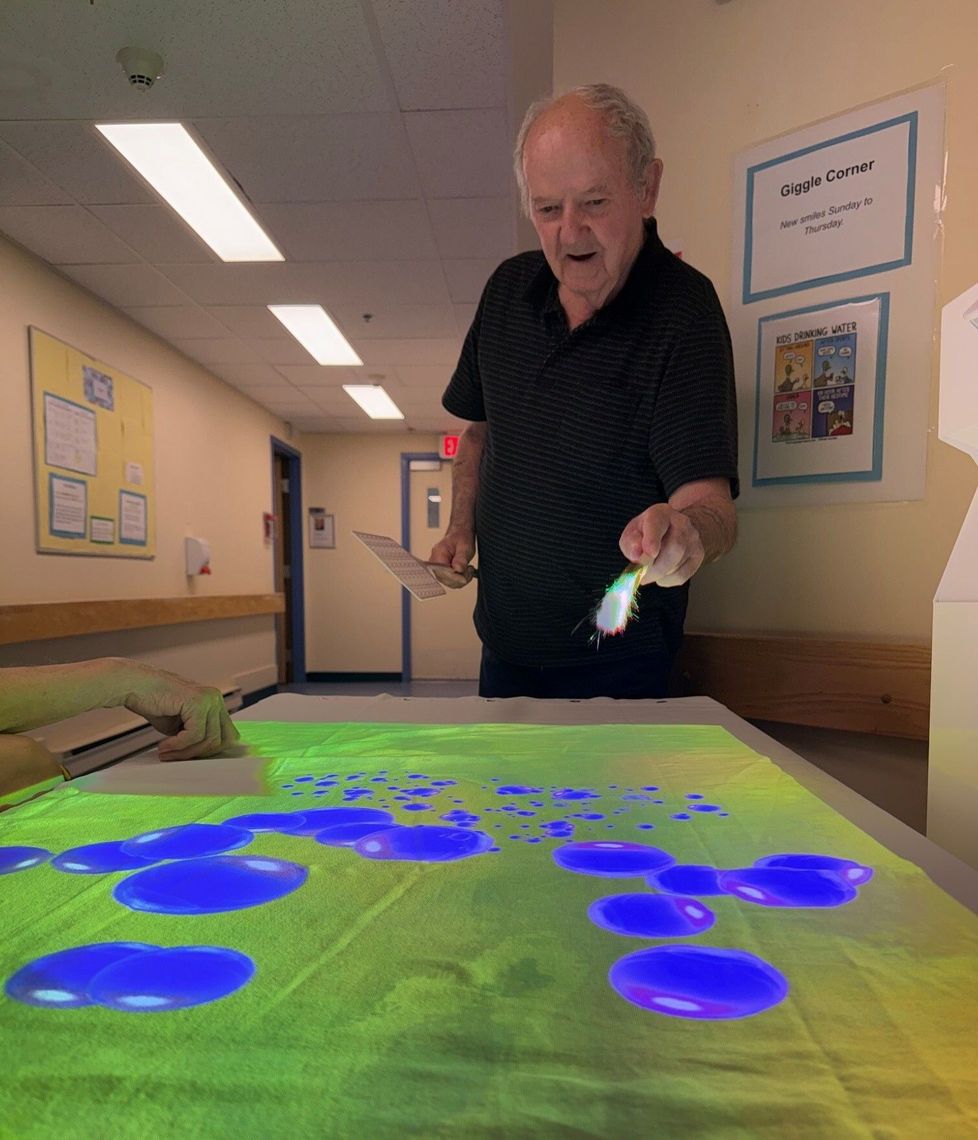
For long-term care residents living with advanced dementia, maintaining social connections and reducing isolation can be a significant challenge. Group recreational activities often require verbal communication or extended attention spans, making it more difficult for residents with complex care needs to engage meaningfully in group activities—if at all. CABHI connected Luther Court Society with Sensory One’s OMI system to determine if this exciting new technology could be the perfect fit.
“CABHI has helped Luther Court bring innovation directly into the everyday lives of residents living with advanced dementia,” says Carolyn Hoekstra, Director of Care and Community, Luther Court Society. “Their support has allowed us to trial technology that creates new possibilities for participation, connection, and enjoyment for residents who may otherwise have limited opportunities to engage in traditional group programming. Ultimately, it’s about finding new ways to enhance quality of life—and CABHI has helped make that possible.”
The interactive projection system creates immersive experiences, allowing multiple residents to participate together through simple movement and visual interaction—no complex communication required. By creating new opportunities for engagement among residents living with advanced dementia, the project has the potential to reduce isolation, strengthen social connections, and enhance quality of life.
-
Making Transitions to and from Bed Safer for LongTerm Care Residents
Falls are the leading cause of injury among older persons, making prevention a top priority. At Baycrest Terraces, care teams were hoping to gain insights into when residents were sleeping, waking, and preparing to leave their beds independently—a prime moment for falls.
As one of the 26 2025/26 CABHI-supported D+A organizations, Baycrest Terraces is implementing Momo Medical’s BedSense (a CABHI-funded innovation): an under-mattress monitoring system designed to provide real-time insights into resident movement, heart rate, and breathing patterns. The technology alerts staff when a resident may be preparing to get out of bed, enabling early intervention when needed, but also promoting independence.
“The pain point we’re trying to solve is to be able to have some insight into when people are sleeping, when they are in the bed, when they are out of the bed, but also we are trying to look for a noticeable reduction in falls,” says Debra Conway-Chung, Director, Residential and Community Programs at Baycrest. “This will be a game-changer for people who are looking for that little bit of an extra touch of care while still allowing autonomy.”
BedSense stood out to Baycrest Terraces because of its non-intrusive design, ease of installation, and app-based reporting, which directly supports the organization’s strategic priorities related to both digital transformation and fall reduction.
The team at Baycrest Terraces expects to see a reduction in falls and an increase in valuable data collection around residents’ sleep and awake patterns. Not only will residents receive better, more customized care by using BedSense, but Baycrest Terraces will be able to schedule staff accordingly.
Mobilizing Knowledge and Market Intelligence with AgeTech Insights
-
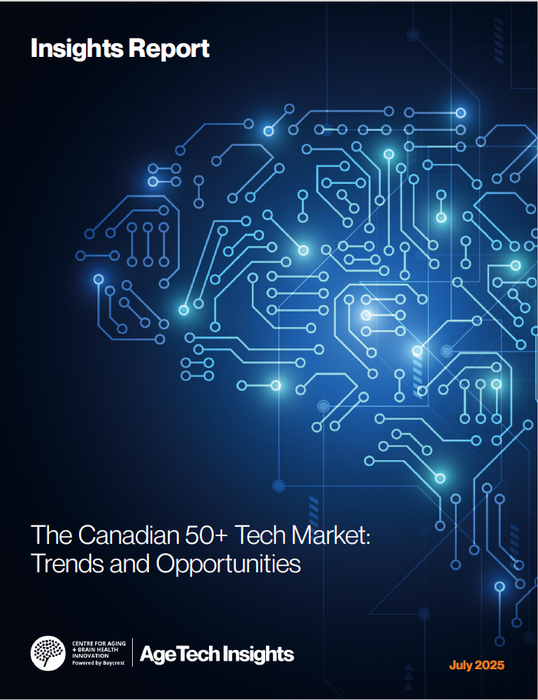
The Canadian 50+ Tech Market: Trends & OpportunitiesTechnology is a part of everyday life for older Canadians+ Daily use of smartphones, tablets, and computers is nearly universal
+ 60% say technology has made life easier
+ Growing adoption of wearables (41%) and smart home tools (39%)
+ Main driver of use is social connection (88%), ahead of convenience or entertainment
-
Designing Inclusive Innovation for the 50+ MarketTechnology use is high—but co-design is lowCanadians 50+ are active digital users, but many do not feel reflected in the products they use.
+ Over 75% use technology daily for banking, connection, entertainment, or information
+ Fewer than 1 in 3 feel technology is designed with them in mind
+ Only 11% believe older adults are meaningfully included in design
-
Supporting Brain Health During MenopauseDigital tools for symptom management are severely lackingMany women experience cognitive and emotional changes during menopause, but few are using digital tools designed for their needs.
+ 77% report symptoms such as memory, focus, mood, and sleep changes
+ Sleep is the most commonly reported challenge
+ 49% are not using any digital tools for symptom management
+ 58% are comfortable using digital technologies