
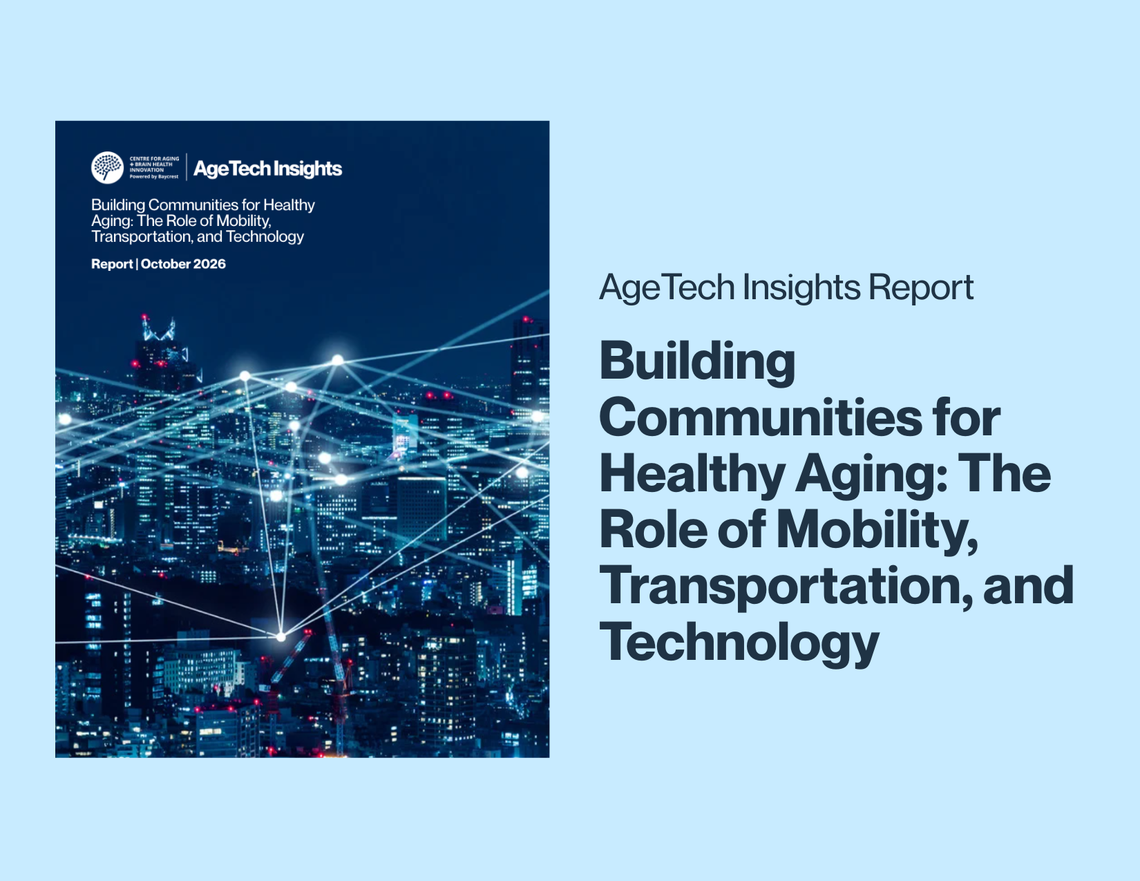
Building Communities for Healthy Aging: The Role of Mobility, Transportation, and Technology
Drawing on the perspectives of more than 2,300 older persons, the report examines the evolving mobility needs, the barriers that older persons continue to face, and the opportunities for technology, age-friendly communities, and cross-sector collaboration to support aging in place. It also highlights how Canada and Japan can learn from one another as they develop more connected, accessible, and person-centred mobility ecosystems.
Browse below to access the report, infographic, and key takeaways in English, French, and Japanese!

Canada and Japan have many similarities. Both are home to super-aged populations facing similar societal challenges, including growing demand for transportation systems, communities, and technologies that enable older persons to remain active, independent, and connected throughout their later years. At the same time, advances in artificial intelligence (AI), digital technologies, and connected mobility in both regions are creating new opportunities to rethink how people move through their communities and access services that support healthy aging.
As healthspan (the number of years a person can live a healthy, active, and connected life) continues to lag nearly a decade behind the average lifespan, innovative, equitable, and community-grounded solutions are needed to help super-aged populations maintain mobility, connection, and access to essential services. With so many parallels between the two countries, it is no coincidence this report puts Canada and Japan at the centre of its focus.
Capitalizing on this opportunity requires collaboration across the entire innovation ecosystem, connecting academia, emerging technologies, coordinated investment, policymakers, companies, and end users to develop, validate, commercialize, and adopt transformative agetech solutions. Interest in solving aging and brain health challenges is increasingly crossing generational lines, with up-and-coming researchers and innovators rising to the occasion. For their part, colleges and universities are developing some of the most promising technologies and practices, bringing research out of the lab and translating findings into real-world applications.
The acknowledgement that aging-related issues are a collective concern is encouraging and indicative of the need for an “inter-ecosystem” approach. The resulting intellectual property from these collaborations is transforming how older persons move, stay connected, and live healthier for longer, and in many cases, expanding overseas for global impact.
Companies are incorporating critical technologies to support age-friendly communities and aging in place, helping older persons stay mobile and connected, while policy creates the conditions for targeted investments in equitable services and infrastructure that support longer healthspans. Like a thriving community, the ecosystem is coming together to tackle the challenges head-on, but the data shows there is more work to be done.
Our latest AgeTech Insights Report explores these challenges and opportunities through a Canada–Japan lens. Drawing on the perspectives of more than 2,300 older persons, the report examines the evolving mobility needs, the barriers that older persons continue to face, and the opportunities for technology, age-friendly communities, and cross-sector collaboration to support aging in place. It also highlights how Canada and Japan can learn from one another as they develop more connected, accessible, and person-centred mobility ecosystems.
This report is a collaborative effort between CABHI and the Ontario Ministry of Economic Development, Job Creation and Trade (MEDJCT); the Japan Research Institute (JRI); the National Center for Geriatrics and Gerontology (NCGG), and the Japan Agency for Medical Research and Development (AMED) Brain/MINDS 2.0. Alongside these partners, we would also like to thank the Ministry of Economy, Trade and Industry (METI) Japan for its support in disseminating the report.
CABHI and our partners are committed to translating research into innovation, commercialization, and societal impact. The findings presented here are intended to inform policy, inspire entrepreneurship, strengthen cross-sector collaboration, and contribute to the development of mobility solutions that enable older persons to age with independence, dignity, and choice.
Mobility is fundamental to healthy aging, enabling older persons to access healthcare, essential services, employment opportunities, exercise facilities, and social opportunities that support independence and well-being: 79% of Canadian respondents and 69% of Japanese respondents reported driving regularly or occasionally to maintain these activities
Aging in place depends on more than housing. Accessible transportation, walkable communities, and proximity to everyday destinations are essential to helping older persons remain active and connected.
While technology is widely viewed as a valuable tool for supporting mobility and independence, more than half of respondents reported not using technology for personal mobility, revealing a significant market opportunity to develop solutions that better align with the needs, preferences, and daily routines of older persons.
Ease of use was the highest priority when using transportation technologies, reported by 54% of respondents in Canada and 61% in Japan, followed by reliability and affordability, underscoring the importance of intuitive, dependable design.
Older persons want technology that supports their mobility and decision-making—such as navigation, safety, and driver-assistance tools—rather than technologies that replace human control, like fully autonomous vehicles.
The future of healthy aging depends on connected ecosystems. Supporting independence will require coordinated investments across mobility and transportation systems, age-friendly communities, and technology and innovation.
Globally, the proportion of people aged 60 years and older is projected to nearly double from 12% in 2015 to 22% by 2050 (World Health Organization, 2025). At the same time, global life expectancy has increased dramatically over the past century, rising from approximately 32 years in 1900 to more than 71 years today (Dattani et al., 2023). However, increases in lifespan do not necessarily translate into equivalent increases in healthspan, or the number of years lived in good health. Globally, the average lifespan is approximately 73 years, while healthspan is estimated at only 64 years, representing a gap of nearly a decade (Garmany et al., 2021). As longevity increases, older adulthood has become increasingly diverse, encompassing individuals with varying levels of health, functional ability, and support needs. Together, these demographic shifts are reshaping how societies plan, deliver services, and support healthy aging.
Population aging is expected to transform labour markets, healthcare and pension systems, housing demand, and patterns of service delivery. It also underscores the importance of creating environments that allow older persons to remain active, connected, and independent. Mobility is fundamental to achieving this goal. Older persons' ability to move safely, confidently, and independently enables them to access healthcare, purchase groceries, engage in physical activity, maintain social relationships, volunteer, work, and participate in community life. By enabling physical activity, social participation, and access to healthcare, mobility supports several modifiable factors associated with healthy cognitive aging and dementia risk, as identified by the Lancet Commission on dementia prevention (Livingston et al., 2024). Conversely, mobility limitations are associated with social isolation, reduced quality of life, declining physical and cognitive health, and increased healthcare utilization (Chihuri et al., 2016).
Maintaining mobility is also critical to older persons’ ability to remain in their homes and communities as they age. Moreover, there are substantial health and economic benefits to enabling older persons to age in or near their own homes (Organisation for Economic Co-operation and Development [OECD], 2025). As older populations continue to grow, investments in accessible mobility solutions, age-friendly transportation systems, and inclusive community design will not only improve individual well-being but also strengthen community resilience, workforce participation, and long-term economic vitality.
Technology is increasingly recognized as a key enabler of healthy aging and mobility. Advances in artificial intelligence (AI), digital health, navigation tools, assistive technologies, connected transportation, and smart city infrastructure have created new opportunities to help older persons maintain independence and overcome barriers to community participation as they age. However, access to and comfort with these technologies are not equal. Differences in digital literacy, affordability, connectivity, accessibility, and confidence can create or reinforce barriers for older persons, particularly as more services move online. Addressing this digital divide requires ensuring that technology complements, rather than replaces, accessible non-digital options and human support. Realizing the benefits of technology therefore depends on solutions that are usable, affordable, accessible, trustworthy, and designed around the priorities and lived experiences of older persons.
Canada and Japan provide valuable case studies for exploring how mobility, community design strategies, and technological innovations can support healthy aging in rapidly aging societies. Both are Organisation for Economic Co-operation and Development (OECD) member countries, making them relevant comparators for understanding how advanced economies are responding to population aging through policy, infrastructure, and innovation. Japan is the world's first super-aged society, with approximately 30% of its population aged 65 years and older, while Canada reached super-aged status as of 2026, with older persons (65 years and older) now surpassing 20% of the population (Press, 2026). Although the two countries differ in geography, culture, transportation systems, and healthcare contexts, both face the common challenge of supporting healthy longevity, maintaining mobility, and enabling older persons to age in place.
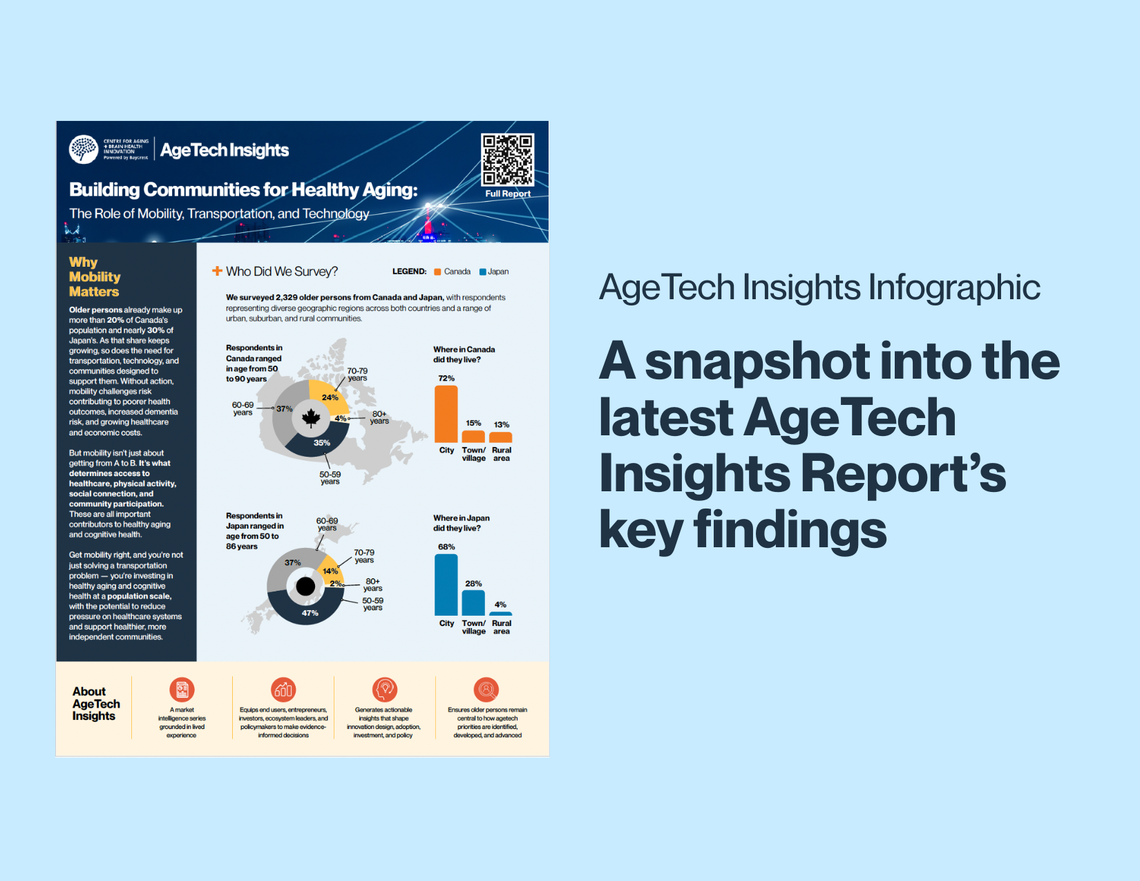
This report draws on findings from a cross-national survey of 2,329 adults aged 50 years and older in Canada (n = 1,034) and Japan (n = 1,295), complemented by interviews with older persons that provide additional insight into lived experiences of mobility, transportation, and technology. Together, these complementary case studies illustrate how different demographic, social, and technological contexts shape experiences of aging and provide practical insights into how transportation systems, community design, technology, and public policy can better support healthy aging, independence, and community participation.
Throughout this report, we use the term “older persons” to describe the population at the centre of this research. While definitions and perceptions of older age vary across countries, cultures, and contexts, for the purposes of this study, “older persons” (see “Key Definitions” on page 5) refers to adults aged 50 and older who participated in the research in Canada and Japan. This study-specific terminology reflects the diversity of experiences, needs, and perspectives within this broad and evolving population.
Market Signals
Below is a high-level summary of the market signals. To dive deeper, download the full report.
-
Signal 1: Mobility is Essential to Independence, and Driving Remains Central to How Older Persons Stay Connected
Driving plays an important role in supporting independence, accessing essential services, and participating in community life as people age. While reliance on driving varies across communities and transportation systems, it remains a key source of mobility for many older persons in both Canada and Japan.
In Canada, 79% of respondents reported driving regularly or occasionally, while 11% had stopped driving. Among those who had stopped driving, the greatest challenges were completing daily errands (45%), visiting friends and family (41%), attending medical appointments (40%), and participating in social or leisure activities (38%). When asked what would have better supported them after they stopped driving, respondents most frequently identified more frequent public transportation (28%), transit routes that better connected them to healthcare, shopping, and other key destinations (27%), more affordable transportation options (25%), and support from family, friends, or community organizations (24%).
A similar pattern was observed in Japan, where 69% of respondents reported driving regularly or occasionally and 17% had stopped driving. However, the impacts of driving cessation appeared to differ from those observed in Canada. Nearly two-thirds (65%) of former drivers reported that stopping driving had resulted in no major change to their daily lives. This may partly reflect the concentration of respondents in more densely populated urban areas, where transportation alternatives are more readily available, and may not fully reflect the experiences of older persons in rural and regional areas of Japan. Among those who did experience challenges, daily errands (14%), participating in social or leisure activities (11%), visiting friends and family (10%), and attending medical appointments (10%) were most affected. The supports identified as most helpful included more frequent public transportation (34%), better transit routes to key destinations (33%), transit stops closer to home (31%), and more affordable transportation options (26%).
-
Signal 2: Aging in Place Depends on Transportation and Community Design
The design of communities can significantly shape how easily older persons are able to move around, access essential services, and participate in daily life. As populations age, creating environments that support mobility and independence is becoming increasingly important for enabling people to age in place.
Canadian respondents generally reported positive perceptions of their communities. Most indicated that essential destinations were easy to reach from home, including grocery stores (95%), pharmacies (95%), medical centres or hospitals (83%), social or community spaces (83%), and family or friends (80%). While access to public transportation was also relatively high (77%), approximately one in ten respondents reported that transit was not available in their area. Most respondents described their neighbourhood as primarily residential (63%), while 32% lived in mixed-use neighbourhoods with nearby shops and services. Overall, 65% reported that their neighbourhood supports aging in place very or somewhat well, and 53% agreed that their city is designed in a way that makes it easy for older persons to get around.
Japanese respondents also reported high levels of access to essential destinations, with 94% indicating grocery stores, 92% pharmacies, 87% medical centres or hospitals, and 89% reporting that public transportation was easy to reach from home. Access to social or community spaces (80%) and family or friends (71%) also remained high. Compared with Canada, a larger proportion of respondents lived in mixed-use neighbourhoods that integrated housing, shops, and services (41% vs. 32%), while fewer lived in primarily residential communities (55% vs. 63%). However, only 43% reported that their neighbourhood supports aging in place, and just 25% agreed that their city is designed in a way that makes it easy for older persons to get around. These findings suggest that perceptions of age-friendly communities extend beyond physical proximity to services or transit.
-
Signal 3: Technology Supports Independence, but Adoption Remains a Challenge
Canada and Japan have both identified technology as a key component of healthy aging strategies
Canadian respondents generally expressed positive attitudes toward technology and reported high levels of confidence using digital mobility tools. Overall, 76% felt very or somewhat confident using these technologies, and three-quarters (75%) agreed that technology helps them remain mobile and independent. Just over half (51%) also agreed that technology helps compensate for limitations in their neighbourhood or city design. Navigation applications (apps) were the most commonly used digital mobility tool (61%), followed by public transportation apps (24%), ride-hailing services (16%), and health or appointment portals (14%). However, one-quarter (26%) reported using none of these digital services. Similarly, more than half (54%) reported using no technologies specifically designed to support their personal mobility. Among those who did, activity-tracking wearables (26%), apps and reminders for daily life (15%), smart home devices (15%), and health-monitoring wearables (11%) were the most commonly used.
Japan is often viewed as a global leader in technology and innovation. However, findings from the survey suggest that the availability of technology does not necessarily translate into widespread adoption or confidence in its use. Overall, 62% of respondents felt very or somewhat confident using digital mobility tools, while 60% agreed that technology helps them remain mobile and independent. Only 36% agreed that technology helps compensate for limitations in their neighbourhood or city design. Similar to Canada, navigation apps (64%) were the most commonly used digital mobility tool, followed by public transportation apps (30%), ride-hailing services (11%), and health or appointment portals (9%), although nearly one-third (29%) reported using none of these digital services whatsoever. More than half (57%) also reported using no technologies to support their personal mobility. Among users, activity-tracking wearables (29%) were the most common, followed by health-monitoring wearables (12%), apps and reminders for daily life (8%), and smart home devices (8%).
-
Signal 4: Adoption Depends on Technology That is Simple, Reliable, and Designed with Older Persons
As populations age, improving mobility requires more than expanding transportation services or introducing new technologies. Older persons must also be able to navigate these systems safely, confidently, and independently. Complex transportation networks, digital interfaces, and fragmented mobility services can create barriers to community participation, particularly for individuals experiencing age-related changes in vision, hearing, cognition, or physical mobility. Even relatively small challenges—such as understanding route changes, transferring between services, locating accessible entrances, or using unfamiliar digital apps—can reduce confidence and discourage travel.Our findings reinforce that many respondents in both Canada and Japan continued to experience practical barriers when navigating their communities. In Canada, the most commonly reported challenges were navigating busy or crowded spaces (18%), making transfers between buses, trains, or other services (17%), understanding routes, schedules, or service changes (17%), knowing where or how to ask for assistance (13%), and getting to appointments on time (12%).
Similar challenges were reported in Japan. Navigating busy or crowded spaces was the most common barrier (20%), followed by making transfers between transportation services (17%), understanding routes, schedules, or service changes (16%), and getting to appointments on time (12%).
-
Signal 5: Trust in Technologies Depends on Simplicity, Support, and Human Choice
Artificial intelligence (AI) represents the next evolution of connected mobility systems. As transportation networks become increasingly digital and interconnected, AI is enabling services to move beyond static infrastructure and fragmented platforms toward systems that can predict, personalize, and adapt in real time.
Respondents in both Canada and Japan expressed moderate levels of trust in digital and automated systems to support mobility, but were more comfortable with technologies that assist decision-making than those that replace human control entirely. In Canada, 59% reported trusting digital or automated systems either "a lot" or "somewhat," while 26% remained neutral and 15% expressed little or no trust. Trust was lower in Japan, where 49% reported trusting these systems, 35% were neutral, and 16% expressed little or no trust.
This difference was even more apparent when respondents were asked about specific technologies. In Canada, half (50%) reported feeling very or somewhat comfortable using AI-based trip-planning tools that recommend routes based on traffic, accessibility, or personal mobility needs. In contrast, only 24% felt comfortable using automated or self-driving vehicles, while 56% reported feeling somewhat or very uncomfortable. In Japan, only 24% reported feeling comfortable using AI-based trip-planning tools, and just 11% felt comfortable using automated or self-driving vehicles, compared with 69% who reported feeling somewhat or very uncomfortable. These findings suggest that building confidence in AI-enabled technology will depend on transparent system design, intuitive and accessible interfaces, clear communication about how AI supports rather than replaces human decision-making, and opportunities for older persons to develop familiarity with these technologies over time.
Respondents also identified clear opportunities to improve transportation technologies. In Canada, the most commonly identified improvements were lower costs (46%), the ability to speak with a real person when needed (38%), clearer instructions (28%), simpler interfaces with fewer steps (28%), and better integration across healthcare, transportation, and city services (24%). In Japan, respondents placed greater emphasis on usability, identifying clearer instructions (47%) and simpler interfaces (42%) as the highest priorities, followed by lower costs (35%), better accessibility features such as larger text and higher contrast (27%), and better integration across systems (21%).

... standing for long periods on trains or other public transport has become a bit difficult. So, I drive to the station, take the Meitetsu line (reserved seat) to Nagoya, and then take the Shinkansen (bullet train) or something similar.
Japanese Interview Respondent


Insights to Inform Innovation
Download the key takeaways to explore how the report findings can support your work and inform solution development.
Download now
Key Takeaways for Innovators
Below is a high-level summary of key takeaways for innovators. To dive deeper, download the full report.
-
Support older persons before, during, and after the transition from driving.
As populations age, there is a growing market for solutions that help older persons drive safely for longer while also supporting a smooth transition to other forms of transportation when driving is no longer preferred or possible.
Innovation opportunities:
Develop technologies that support safer driving, including driver-assistance systems, in-vehicle health and safety monitoring, and navigation systems designed for age-related needs.
Build services that make the transition away from driving easier, including on-demand community shuttles, volunteer driver programs, concierge transportation, and tools that connect driving with public transit and ride-sharing.
Recognize older persons as a key consumer market by designing mobility products and services around their needs, preferences, and purchasing power.
-
Use technology to make communities easier to navigate.
Mobility extends beyond transportation. The ability to find accessible routes, navigate the built environment, and connect with nearby services can determine whether older persons are able to participate fully in their communities and maintain their independence.
Innovation opportunities:
Develop tools that provide real-time accessibility information, such as accessible entrances, elevator outages, sidewalk conditions, and other barriers that can affect a journey.
Connect older persons with nearby healthcare, recreation, community services, and other resources that support independent living.
Tap into the growing longevity market by developing navigation and community-access solutions that address the needs of older persons. As this population grows, so does its economic influence and demand for products and services that support mobility, accessibility, and independent living.
-
Connect fragmented services into one seamless experience.
Transportation, healthcare, and community services often operate separately, requiring older persons to navigate multiple systems to meet their everyday needs. Innovators have an opportunity to reduce this complexity by connecting services around the individual.
Innovation opportunities:
Develop Mobility-as-a-Service (MaaS) platforms that integrate public transit, ride-hailing, community transportation, and payment systems.
Connect mobility with healthcare through tools that coordinate transportation with medical appointments or combine trip planning, scheduling, accessibility information, and community resources in one place.
Prioritize interoperability and affordability so that technologies work across providers and respond to diverse mobility needs.
-
Make co-design and universal design a market advantage.
Older persons are not a single, uniform user group. Mobility technologies must accommodate a wide range of physical, sensory, cognitive, and technological abilities. Involving older persons throughout product development can improve usability, trust, and adoption while reducing the need for redesign after implementation.
Innovation opportunities:
Co-design with older persons throughout design, development, and evaluation so products reflect real-world needs and preferences.
Prioritize intuitive interfaces, clear instructions, minimal cognitive demands, and accessibility features.
Design for a broader market. Universal design can benefit older persons, people with disabilities, care partners, and people experiencing temporary or changing mobility needs.
-
Build artificial intelligence (AI) that supports decisions without taking away control.
As AI becomes more commonly integrated into transportation systems, the opportunity may lie less in replacing human decision-making and more in helping people make mobility decisions with greater confidence.
Innovation opportunities:
Prioritize AI-enabled navigation, trip planning, and decision-support tools that help users make informed travel decisions while maintaining control over their journeys.
Build trust through transparency and user control, including recommendations that can be easily understood and overridden.
Combine personalization with intuitive interfaces, accessible design, and the ability to connect with a real person when needed to strengthen confidence and long-term adoption.

Insights to Inform Policy
Download the key takeaways one-pager to explore how the report findings can support your work and inform policy.
Download now
Key Takeaways for Policymakers
Below is a high-level summary of key takeaways for policymakers. To dive deeper, download the full report.
-
Plan for mobility across the life course, including the transition from driving.
Driving remains an important source of independence for many older persons, but mobility needs can change over time. Policy should support safe driving while ensuring that transitioning away from driving does not mean losing access to healthcare, essential services, employment, or community life.
Policy opportunities:
Pair licensing assessments, driver education, and road safety initiatives with continued investment in accessible public transit, community transportation, and age-friendly community design.
Build population aging into long-term infrastructure and fiscal planning. Investing in accessible mobility can support independence and aging in place while helping reduce pressure on healthcare, long-term care, and other public services.
Ensure older persons have viable alternatives to driving so they can remain socially connected, engaged in their communities, and able to access healthcare and essential services throughout the life course.
-
Treat age-friendly communities as an investment in healthy aging.
Where people live can determine how easily they remain independent and engaged as they age. Accessible housing, walkable neighbourhoods, safe pedestrian infrastructure, reliable public transportation, and nearby community services can support aging in place while enabling older persons to continue contributing socially and economically.
Policy opportunities:
Invest in accessible housing, universal design, walkable neighbourhoods, safe pedestrian infrastructure, reliable public transportation, and integrated community services.
Recognize mobility and community infrastructure as part of the broader healthy aging ecosystem. These investments can help older persons remain employed, volunteer, provide unpaid caregiving, access preventive healthcare, and participate in local economies and community life.
Prioritize investment where age-friendly infrastructure gaps are greatest. Expanding accessible housing and community-based services can support aging in place, reduce demand for more costly forms of care, and strengthen the sustainability of public systems.
-
Connect transportation, healthcare, and community services around the person.
Fragmented transportation, healthcare, and community services can make everyday mobility complex, particularly when people must navigate separate providers, booking systems, and payment systems.
Policy opportunities:
Support interoperability and cross-sector collaboration among municipalities, transportation agencies, healthcare providers, and community organizations.
Make affordability a core component of mobility policy. Digital tools can make transportation easier to navigate, but their benefits will remain out of reach if the transportation options themselves are unaffordable.
Invest in integrated and affordable mobility systems that make it easier for older persons to access healthcare and community services while supporting more efficient, sustainable, and person-centred models of care as demand for health and long-term care grows.
-
Support responsible adoption of digital health and AI through evidence and trust
Transportation systems and technologies are more likely to be accessible, trusted, and usable when the people who rely on them are involved in their design.
Policy opportunities:
Embed co-design requirements into public procurement, funding, and evaluation processes for transportation technologies and services.
Engage older persons and care partners throughout planning, development, implementation, and evaluation.
Promote universal design standards, accessible digital services, and digital literacy initiatives so that transportation systems remain usable across different physical, sensory, cognitive, and technological abilities and throughout the life course.
-
Build trust and accountability into AI-enabled mobility from the start.
As AI becomes more commonly integrated into transportation and mobility systems, policy frameworks will need to ensure that innovation does not come at the expense of accessibility, privacy, transparency, or user control.
Policy opportunities:
Establish governance frameworks and standards for transparency, accessibility, privacy, and oversight in AI-enabled mobility systems.
Invest in digital literacy so older persons have the knowledge and confidence to understand and use emerging mobility technologies.
Encourage collaboration among transportation agencies, technology developers, healthcare systems, and community organizations to ensure AI-enabled solutions are trustworthy, inclusive, and responsive to the needs of aging populations.
Access the full report
Interested in learning more about evolving mobility needs, barriers that older persons continue to face, and opportunities for technology, age-friendly communities, and cross-sector collaboration to support aging in place? Download the new AgeTech Insights report now!