Unlocking the Economic Power of Caregiving in Canada

Reports + Articles Caregiver support Care coordination + navigation | CABHI + the Canadian Centre for Caregiving Excellence|

As Canadians age and neurological conditions become more prevalent, protecting brain health is no longer just a healthcare priority; it is also an economic one. Cognitive health, mental well-being, and neurological resilience are increasingly central to innovation, productivity, and the overall quality of life of a nation, fueling what is now understood as the brain economy. However, one of the most essential pillars supporting the brain economy remains largely invisible: caregivers. 

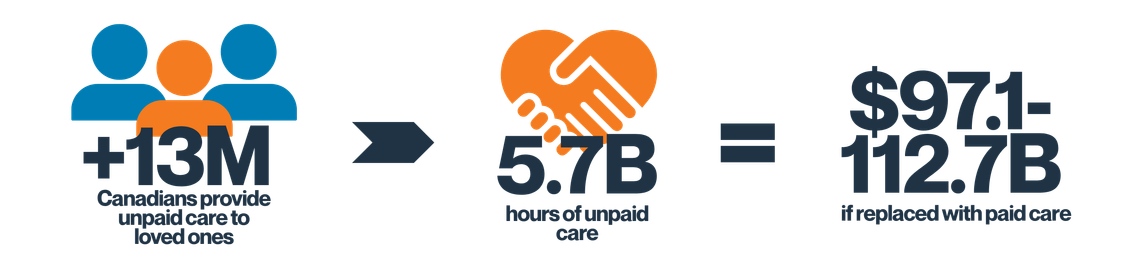
Across Canada, more than 13 million people provide unpaid care to individuals living with illness, disability, or age-related changes in support needs (Statistics Canada, 2024). Most caregivers (67%) are caring for someone over the age of 65, and with dementia rates rising, this will only compound the challenge of caregiving (Canadian Centre for Caregiving Excellence, 2026). Caregivers coordinate medical appointments, manage medications, monitor symptoms, and help navigate complex healthcare systems on behalf of their loved ones. Their contribution is immense. Canadians provide an estimated 5.7 billion hours of unpaid care each year, work that would cost the healthcare system between $97.1 billion and $112.7 billion annually if replaced with paid services (Fast et al., 2024). Caregivers are effectively sustaining the health and social care systems that millions rely on. 

Depiction of caregiving stats in Canada for 2026

Efforts to strengthen caregiver well-being are being advanced in part through innovation in aging and brain health, including work supported by the Centre for Aging + Brain Health Innovation (CABHI), powered by Baycrest. Through capacity building initiatives, tailored funding programs, and acceleration services, CABHI supports the development and adoption of Canadian science and technology-driven solutions that strengthen brain health and contribute to a stronger brain economy. Complementing these efforts, the Azrieli Foundation’s Canadian Centre for Caregiving Excellence (CCCE) is advancing knowledge of the experiences of caregivers in Canada while advocating for the public policy solutions and system-level changes needed to better recognize and support caregivers. By recognizing brain health as a form of brain capital (the combination of brain health and brain skills) and investing in the systems and people that sustain it, including caregivers, these efforts are supporting everyday Canadians while unlocking our full economic potential. 

Caregivers play a vital role in supporting health across the entire life course. Many children and youth living with physical, mental health, or brain-based disabilities depend on caregivers for daily cognitive, emotional, and logistical support. In Canada, 1 in 10 children and youth live with a neurodisability, yet timely diagnosis and care are often out of reach. Families face years-long waitlists, limited access to essential services, and significant out-of-pocket expenses for supports and therapy, with costs that can reach up to $80,000 annually.  

Graphic with stats about children with neurodisabilities

Access to community-based supports helps children, youth, and adults live with dignity, autonomy, and connection in their communities, and significantly improves quality of life. Kids Brain Health, a valued partner to both CABHI and CCCE, provides evidence-based programs for children and youth living with neurodisabilities, including caregiver support programs. For example, the Acceptance and Commitment Training program, supported by Kids Brain Health Network, is an impactful caregiver-focused initiative designed to address the high levels of stress and isolation experienced by family caregivers of children and youth living with neurodisabilities. Moreover, many middle-aged adults, often called the “sandwich generation,” are raising children while caring for aging parents. These overlapping responsibilities can be exhausting, leaving caregivers stretched thin and constantly balancing competing demands. This highlights the scale of their contribution: CCCE’s recent research report, Caring in Canada 2026, found that unpaid caregivers provide three hours of care for every hour delivered by formal health services, demonstrating how deeply healthcare systems depend on this invisible workforce. While families want to care for those in their lives who are in need of support, caregiving can come with deep personal impacts. The latest data indicate that 77% of caregivers report negative impacts on their well-being, with many experiencing financial strain and difficult trade-offs related to work, education, family life, and their own health (CCCE, 2026). 

Caregiving places significant demands on brain health. It is not only physically demanding but also cognitively and emotionally taxing. Chronic stress, sleep disruption, and emotional strain are common among caregivers and have been linked to increased risk of depression, anxiety, and cognitive fatigue (Schulz & Sherwood, 2008). Critically, nearly 1 in 5 caregivers of older adults are themselves over the age of 65 (CCCE, 2024). For these older caregivers in particular, such pressures can contribute to declining mental and cognitive health, increasing vulnerability to neurological conditions such as dementia. In other words, caregivers are often part of the very population most at risk of the brain health challenges they are helping others manage. Supporting caregivers is therefore a brain health intervention. It protects the well-being of those providing care while improving the conditions of those receiving it.  

Technology offers important opportunities to strengthen both caregiver well-being and brain health outcomes. A growing ecosystem of digital health and agetech innovations, including those supported by CABHI, is emerging to support caregivers and older adults. Caregiving-focused platforms such as Tuktu Care help connect older adults and family caregivers to trusted local support for everyday needs, including companionship, transportation, errands, housekeeping, and other non-medical services.  

“At Tuktu Care, we see every day how much invisible coordination caregivers take on. Technology should not replace human care, but it can reduce stress, simplify logistics, and help families find trusted support faster so caregivers can focus more on their loved ones and less on managing everything alone.”

Rustam Sengupta, Tuktu Care

Solutions like blueBell Connect bring together families, caregivers, and care providers in a shared digital space to coordinate care, share updates, and access personalized, clinically informed support. Tools such as Consoul are designed to reduce caregiver burnout by automating time-consuming tasks and supporting care coordination, helping caregivers focus on their own well-being.  

Together, these technologies are streamlining care navigation and can support caregiver brain health and well-being by reducing stress and enabling more informed, personalized decision-making. To be effective, these tools must be accessible, affordable, culturally relevant, and designed with the people who will use them, including caregivers, people with disabilities, older adults, and care providers. 

While innovation in digital health and agetech is accelerating, policy and investment frameworks have not fully recognized caregivers as essential partners in the healthcare system and society at large. Empowering Canada’s caregivers requires a coordinated approach that integrates technology development, sustained adoption, policy reform, and economic strategy. Recognizing caregiving as essential to the brain economy requires policies that support caregivers across multiple levels, including expanded caregiver benefits, workplace protections, and targeted investments in caregiver-centred technologies. 

Canada is already making moves. CCCE has proposed a national caregiver strategy that recognizes caregivers as an essential component of the healthcare system, with action across five key areas: supports and services, work and education, financial supports for care recipients, workforce sustainability, and leadership and recognition (CCCE, 2025). Across each of the pillars proposed by CCCE, there is a clear opportunity to more intentionally integrate technology as part of the solution—a gap that organizations like CABHI are actively addressing. Innovation funding can prioritize solutions across the lifespan designed with caregivers in mind, while policies can incentivize the development, adoption, and scaling of technologies that address real-world caregiving challenges, from care coordination and remote monitoring to cognitive and mental health supports. Importantly, caregivers themselves should be included in the design and development of new technologies to ensure solutions reflect lived experience and daily care realities. So should disabled people, older adults, and care providers, because technology that is designed without the people most affected by it rarely solves the right problems. 

“Caregiving is central to our health and social care systems, our communities, and our economic future. If we want a stronger brain economy, we need to invest not only in innovation, but in the people, relationships, and supports that make caregiving possible every day.”

Liv Mendelsohn, Executive Director, Canadian Centre for Caregiving Excellence

In the brain economy, the role of caregivers is impossible to ignore. Caregivers sustain healthcare systems and enable aging populations to remain in their communities, and technology can play a transformative role in supporting them to do so. Supporting caregivers is not simply about easing pressure on families. It is about protecting brain health, strengthening national productivity, and building a more resilient, innovation-enabled healthcare system for the future. It is also about recognizing that we all give and receive care, and that a society serious about brain health must be equally serious about dignity, access, inclusion, and interdependence. 

Interested in learning more about caregiving and your brain health? Check out past episodes of Baycrest’s Defy Dementia Podcast, Reduce Your Stress for Brain Health, and Brain Health for Caregivers 

Read more about caregiving in Canada

references

Canadian Centre for Caregiving Excellence. (2026). Caring in Canada 2026.  
https://canadiancaregiving.org/wp-content/uploads/2026/05/Caring-in- Canada_web.pdf 

Canadian Centre for Caregiving Excellence. (2025). A national caregiving strategy for Canada. https://canadiancaregiving.org/wp-content/uploads/2025/02/National-Care-Giving-Strategy-FINAL-WEB.pdf 

Canadian Centre for Caregiving Excellence. (2024). Caring in Canada: Survey insights from caregivers and care providers across Canada. https://canadiancaregiving.org/wp- content/uploads/2024/06/CCCE_Caring-in-Canada.pdf 

Fast, J., Duncan, K. A., Keating, N. C., & Kim, C. (2024). Valuing the contributions of family caregivers to the care economy. Journal of Family and Economic Issues, 45(1), 236-249. 

Schulz, R., & Sherwood, P. R. (2008). Physical and mental health effects of family caregiving. Journal of Social Work Education, 44(3), 105-113. 

Statistics Canada. (2024). “Sandwiched” between unpaid care for children and care-dependent adults: A gender-based study. https://www150.statcan.gc.ca/n1/pub/89-652-x/89-652-x2024002-eng.htm 

Subscribe to the CABHI newsletter

* indicates required