
Designing Inclusive Innovation for the 50+ Market
Reports + Data
Diversity, accessibility + health equity
|
This report is a collaboration between CABHI and the International Federation on Ageing (IFA). It pairs CABHI’s expertise in end‑user research with the IFA’s global policy leadership to shape strategic priorities and support healthier aging worldwide.

CABHI and IFA emphasize the importance of co‑design, equity, and meaningful engagement of older adults in innovation. They highlight the growing need for age‑inclusive technology and acknowledge how digital tools can support independence, dignity, and social participation—while warning that older adults are too often excluded from design.
Canada’s aging population is rapidly increasing its use of digital technology. Most older adults use the internet daily, rely on digital tools for communication and tasks, and show strong interest in technology—yet face barriers such as cost, privacy concerns, scams, and poor age‑friendly design. Despite high adoption, Canadians 50+ remain underrepresented in technology design and engagement opportunities.
Technology adoption is high across every domain, especially for accessing services, managing finances, social connection, and entertainment. However, barriers persist—privacy concerns, usability challenges, trust issues, and cost. Only a minority feel that technology is designed with them in mind, yet over half are interested in co‑design. Geographic and age variations also shape adoption patterns, creating opportunities for more localized design and inclusive innovation.
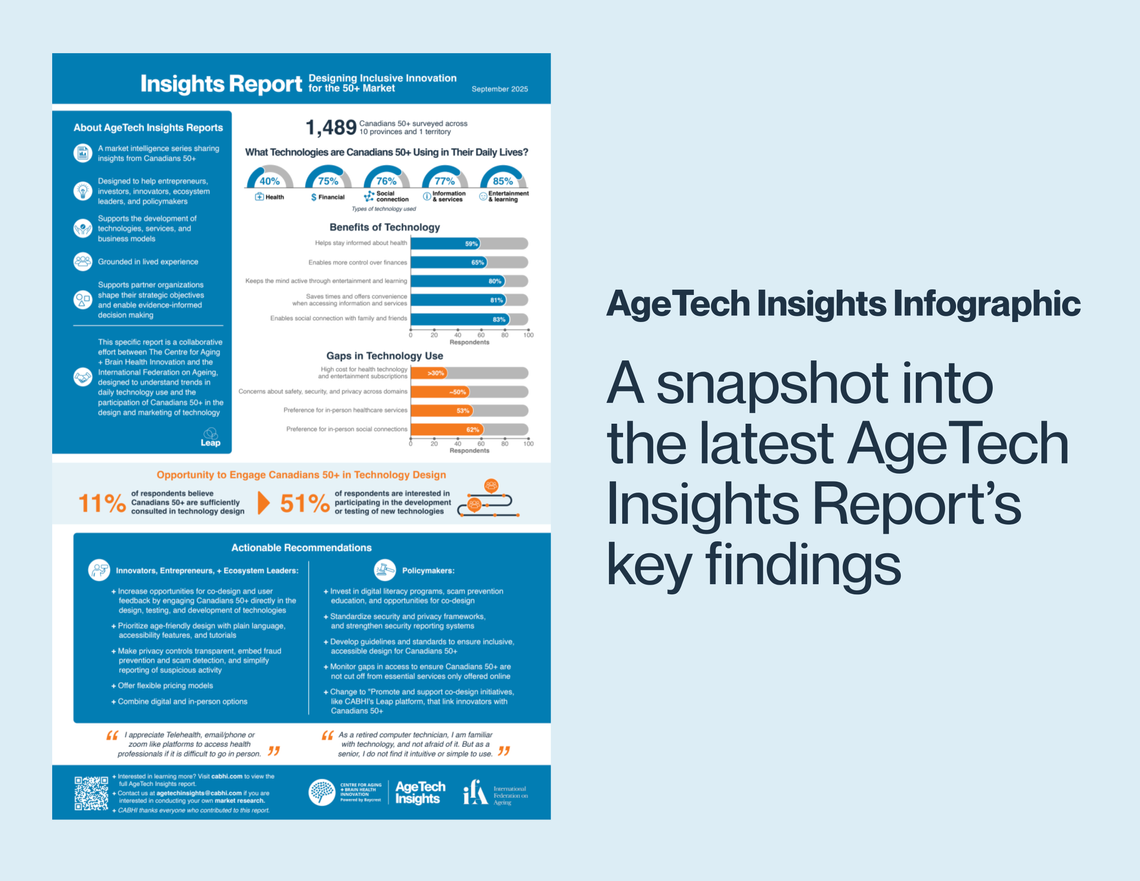
CABHI and IFA surveyed 1,489 Canadians aged 50+ to understand how they use technology in daily life—across health, finances, social connection, services, and learning—and to explore their engagement in the design and marketing of new technologies.
The online survey ran for two weeks and reached diverse participants across 10 provinces and one territory. Respondents ranged from age 50 to 90+, predominantly female, mostly English‑speaking, and generally well‑educated, with varied income levels and health conditions.
CABHI’s AgeTech Insights initiative offers market intelligence into the growing demands of the national and international aging population, encouraging co-design approaches that connect innovators with older persons.
The collaboration between the CABHI and the IFA is an exciting one. With our shared goal of improving quality of life for older persons combined with our unique positions as thought leaders in healthcare innovation and national and global policy, we aim to promote inclusive, impactful, and scalable technologies, services, programs and policies. CABHI is happy to support the IFA to better understand the AgeTech market in Canada with the publication of this report
—-Dr. Allison Sekuler, President and Chief Scientist, Centre for Aging + Brain Health Innovation (CABHI) and Natalie Leventhal, Principal Investigator for AgeTech Insights Initiative and Knowledge Broker, CABHI
Technology holds immense promise for enabling independence, connection, and dignity as we age. Yet too often, older people are excluded from its design and implementation. IFA believes that innovation must be grounded in equity, shaped by the lived experiences and voices of older persons, and driven by the realities of demographic change.
This report is an important step towards this—by understanding how technology can better enable the participation of older persons and support healthy ageing. The collaboration behind this work reflects IFA and CABHI’s shared vision and commitment to ensuring that no one is left behind in the digital age. The IFA is grateful to all who are contributing to this effort. Together, we are shaping a future where technology serves as an active agent in improving lives for everyone, at every age.”
—Katrina Bouzanis, Director, Policy and Advocacy, International Federation on Ageing (IFA), and Sonia Hsiung, Chief Strategy Officer, International Federation on Ageing (IFA)
High Adoption Across Domains: Canadians 50+ report strong and regular use of technology, with particularly high adoption for accessing information and services (85%) and financial management (75%). Engagement is strong for social connection (76%) and entertainment and learning (77%). Technology for health management remains lowest at 40% regular use; however, 72% of respondents are aware of these technologies, highlighting an opportunity for innovators to co-design solutions that address specific barriers to adopting health technology.
Existing Barriers: Barriers vary depending on technology use. Cost is a greater barrier in health (31%) and entertainment and learning (32%) technologies than in financial tools, where 75% of respondents say cost is not an issue. Privacy and security concerns are widespread, reported by about half of respondents for health, finance, entertainment, and information and service related technologies. Trust levels differ by domain, financial tools are generally trusted (57%), while trust is lower for health technologies (37%). Usability concerns are more common in health management tools (only 41% find them easy to navigate) compared to finance (63%) or entertainment (70%). These barriers point to opportunities for co-design with older persons to simplify interfaces, build trust, and align pricing models with user needs.
Benefits: Canadians 50+ value the convenience, independence, time savings, and social connectivity that technology offers. Technologies that support hybrid models, combining digital with in-person services, are especially important for healthcare and social connection. Involving Canadians 50+ in the design of technology, especially hybrid solutions, can ensure technologies are developed in ways that reflect user preferences and address real-world barriers.
Design Gaps: Fewer than 1 in 3 respondents feel technology is designed with them in mind, and only 11% believe older persons are sufficiently consulted in design. Lack of inclusion in technology design is itself a barrier to adoption and trust, underscoring the need for structured, ongoing co-design approaches that give older Canadians agency in shaping technologies.
Strong Interest in Co-Design: More than half (51%) of survey respondents are interested in participating in testing and design. This demonstrates a significant opportunity for innovators to address barriers (e.g., usability, trust, accessibility) by directly engaging end-users in product development, validation, and refinement.
Differences by Geography: Adoption varies across provinces and territories. For example, regular use of healthcare technology is lower in regions such as the Yukon (8%) and Newfoundland and Labrador (18%), compared to higher uptake in larger provinces like Ontario and British Columbia. Respondents in Prince Edward Island report the strongest interest (71%) in using technology more for social connection. Regional differences highlight the importance of place-based co-design approaches that adapt co-design frameworks to local contexts and barriers.
Differences by Age: Technology adoption is generally consistent across most age groups; however, older respondents (90+) show the strongest preference for in-person healthcare (66%). Interestingly, this group also reports high recognition of the convenience of digital access for information and services. Engaging end-users of all ages in technology design will encourage adaptive design and the development of technologies that are user-friendly for a wider range of users.
Opportunities for Innovation: Innovators can expand market potential by embedding co-design into product development. By engaging Canadians 50+ directly in the design and testing of technology, innovations are more likely to overcome barriers of usability, trust, and affordability, while aligning with real-world preferences. This approach not only improves uptake and sustained use but also strengthens market fit, positioning innovations to capture a growing consumer base.
Opportunities for Policy Change: Policymakers can expand digital literacy programs, enforce inclusive design and data protection standards, strengthen national scam prevention systems, and fund and promote co-design initiatives that connect innovators with older Canadians.
Key Findings
-
Using Technology to Manage Health
Awareness of health technology is high, but regular use is low. Respondents value convenience, access to providers, and greater control over health. Barriers include cost, usability issues, limited functionality, trust concerns, and strong preference for in‑person care—especially among those 90+. Usage also varies across regions, with lower adoption in the Yukon and Newfoundland and Labrador.
-
Using Technology to Manage Finances
Financial technology shows the strongest adoption of all categories. Most respondents use digital tools regularly, find them easy to use, and see clear benefits like saving time and staying informed. Trust is moderate, with privacy concerns persisting, and a significant portion still prefers in‑person or phone‑based services. Cost is generally not a barrier.
-
Using Technology for Social Connection
Three‑quarters of respondents regularly use digital tools to stay socially connected, citing convenience, ease of use, and ability to stay in touch with loved ones. While cost is not a significant issue, more than half still prefer in‑person or phone interactions, and confidence varies by region.
-
Using Technology to Access Information + Services
Respondents show strong adoption of digital platforms to access information and services. They find these tools functional, efficient, and empowering. However, privacy concerns, preferences for offline interactions, and occasional usability challenges remain barriers.
-
Using Technology for Entertainment + Learning
Entertainment and learning technologies have high adoption and satisfaction. Respondents value mental stimulation, convenience, and access to activities not available in person. Barriers include subscription costs, usability frustration, and preference for traditional media.
-
From Users to Co‑Creators
Most respondents feel they have autonomy in choosing technology and believe it supports independence. However, few feel technology is designed for Canadians 50+, and even fewer believe they’re properly consulted in design. Despite this, more than half are eager to participate in co‑design or testing.

Discussion
The agetech market is growing quickly, but gaps remain across use, trust, and equitable access. Older adults—especially those 90+ and those in smaller provinces—have distinct needs. Co‑design is a major untapped opportunity. Without inclusive design and policy support, older adults risk being left behind in an increasingly digital society.
Recommendations
Key actions include expanding co‑design, improving usability, prioritizing accessibility, integrating systems, building trust through privacy transparency, addressing cost barriers, offering hybrid models, and embedding strong scam/fraud prevention. Regional variability should shape tailored outreach, training, and product development.
Policy recommendations emphasize expanding digital literacy, enforcing data protection, funding access to health technology, establishing age‑friendly design standards, promoting interoperability, improving system efficiency, building scam‑prevention systems, reducing financial barriers, and funding co‑design capacity building.
Access the full report
Interested in learning more about how Canadians ages 50+use technology in daily life?