Sign up to be notified
Be the first to know when we release new actionable data and insights

Older Canadians want—and need—supportive agetech for better brain health

How do Canadians really feel about growing older? What do they need to support them as they age? Are there tools or technologies they use—or wish existed—to improve the aging experience? As Canada’s population ages rapidly, these questions are more important than ever. The AgeTech Insights team at the Centre for Aging + Brain Health Innovation (CABHI), powered by Baycrest, is working to answer them.
In Canada, nearly 20% of the population is already over the age of 65, and this number is projected to triple by 2050. Globally, by 2030, an additional 300 million people are expected to be over the age of 65 compared to 2023. As populations age, the prevalence of age-related cognitive decline and disease, including dementia, increases. Currently, over 770,000 Canadians are living with dementia, and by 2050, that number is expected to increase to nearly 1.7 million.
Our AgeTech Insights team of experts has recently been focused on better understanding how Canadians experience aging—particularly in relation to cognition and brain health— and how technology is, or could be, used to support aging with purpose, fulfilment, and dignity.
Canadians are overwhelmingly aware of cognitive changes that occur as they age and are concerned about their brain health
Comfort levels with technology are high, but not when it comes to using it to support brain health
Current technologies do not meet needs and do not engage users during the design process
Across all AgeTech Insight Reports to date, Canadians are noticing cognitive changes as they age and are concerned about their brain health. When surveyed about technology, respondents consistently ranked memory and brain training tools as a leading area of interest, demonstrating that cognitive health is top-of-mind as they age.

Women, specifically, have major concerns about cognitive health beginning in midlife when menopause typically occurs, as revealed in our upcoming AgeTech Insights Report. When surveyed, 77% of women 40+ noted that memory and mood can be impacted during the menopause transition—the stages before, during, and after menopause, including emotional, physical, and cognitive changes—as they age. This demonstrates that awareness of brain health and cognitive changes is widespread from midlife through to older adulthood.
Although Canadians are concerned about their brain health as they age, technology use in this particular area remains low—but not due to lack of comfort with technology overall.
75% of Canadians 50+ regularly use technology for personal finances, and 76% for social connection, depicting a high overall adoption rate with technology. However, the use of technology for health management drops: Only 40% of Canadians 50+ reported using technology for this purpose.
This trend is consistent among women aged 40+: Nearly 60% of women report being comfortable using technology, yet about half of those who experience cognitive or mental health challenges do not use any digital tools to help manage those issues. These findings exemplify that low uptake is likely not due to use barriers associated with technological understanding and comfort, but rather the usefulness of tools currently on the market.

We now know that older Canadians are concerned about their brain health as they age and are generally comfortable using technology. This raises an important question: Do older persons feel they have the technological tools they need to support and improve their brain health?
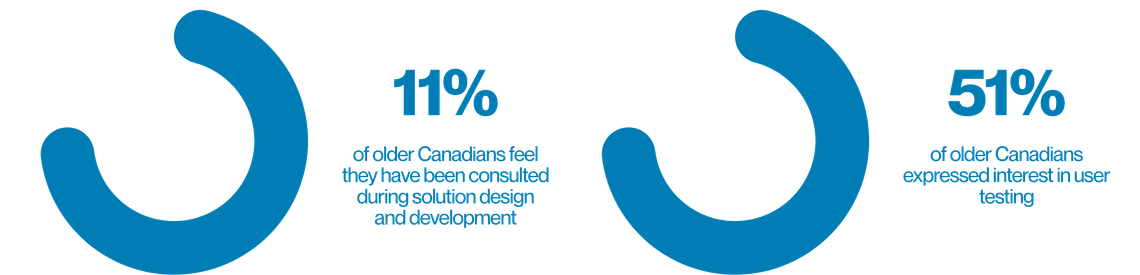
Our second AgeTech Insights Report, published in partnership with the International Federation on Ageing, zeroed in on inclusive technology design for Canadians 50+. The AgeTech Insights team discovered a lack of co-design; only 11% of older Canadians feel they have been consulted during solution design and development, despite 51% expressing interest in user testing. Without meaningful co-design, technologies often miss the mark.
As we continue to experience major demographic shifts worldwide, questions pertaining to the types of technology older Canadians want and the gaps in agetech offerings are not only top of mind but also top of market. In 2025 alone, agetech companies raised over $700M, and over the next four years, the broader dementia treatment market, which includes technology-supported solutions, is expected to grow 8% year-over-year.
Evidence shows that concerns about cognitive decline throughout the aging experience are present, and adoption of everyday technologies is already high, but the available solutions on the market are not tailored to the needs of the target audience. For market growth to translate into lasting impact, emerging technologies must be designed with older persons—the end users—at the core. There is a massive opportunity to develop agetech solutions that thoughtfully address the needs of older persons while also contributing to economic growth in Canada.
This summary is just the beginning! Our AgeTech Insights team is continuing to uncover market trends and service gaps to inform scientists, researchers, innovators, entrepreneurs, and policymakers on the needs of older persons. As we begin calling on our new AgeTech Insights Fellows as strategic advisors and co-authors, reports will have input from industry-leading experts who bring deep knowledge and expertise across disciplines, helping us turn insights into action.
Our AgeTech Insights Report about women’s brain health is coming out in March 2026; if the statistics on women aged 40+ and the menopause transition piqued your interest, stay tuned!
Sign up to be notified
Be the first to know when we release new actionable data and insights